
AARRR, Dave McClure's Pirate Metrics, is one of those frameworks every B2B SaaS founder learns in their first month. Acquisition, Activation, Retention, Referral, Revenue. Five stages, one acronym, a generation of teams raised on it.
Eight years on, four of its five stages still hold up.
The fifth — the first A for Acquisition — broke in the AI era.
This post is about which part of AARRR aged badly, why, and what a sharper replacement looks like for B2B SaaS in 2026.
What AARRR got right
McClure published AARRR in 2007. Eighteen years ago. The fact that it still maps to most of what a B2B SaaS founder cares about is a credit to the design.
Retention is still the right name for the question "do they come back." Cohort retention curves are still how serious teams measure product-market fit. The leaky-bucket image — a funnel where retention determines whether anything else matters — holds up.
Referral is still real. Word of mouth is still the cheapest channel. NPS is still imperfect but still useful.
Revenue still pays the bills. The distinction between paid conversions, expansion revenue, and churn-adjusted MRR still organizes how SaaS teams think about money.
If a founder were starting a SaaS today and was only allowed one framework, AARRR would cover four-fifths of what they need.
But that first A. That one broke.
The specific thing that broke
In 2007, "Acquisition" was one box because there was one door.
Most B2B SaaS got customers through Google. Either through paid ads or organic ranking. That was acquisition. There were edge cases — Reddit threads, banner ads, conferences — but the gravity well of customer discovery was Google. One channel, one set of metrics, one box in AARRR.
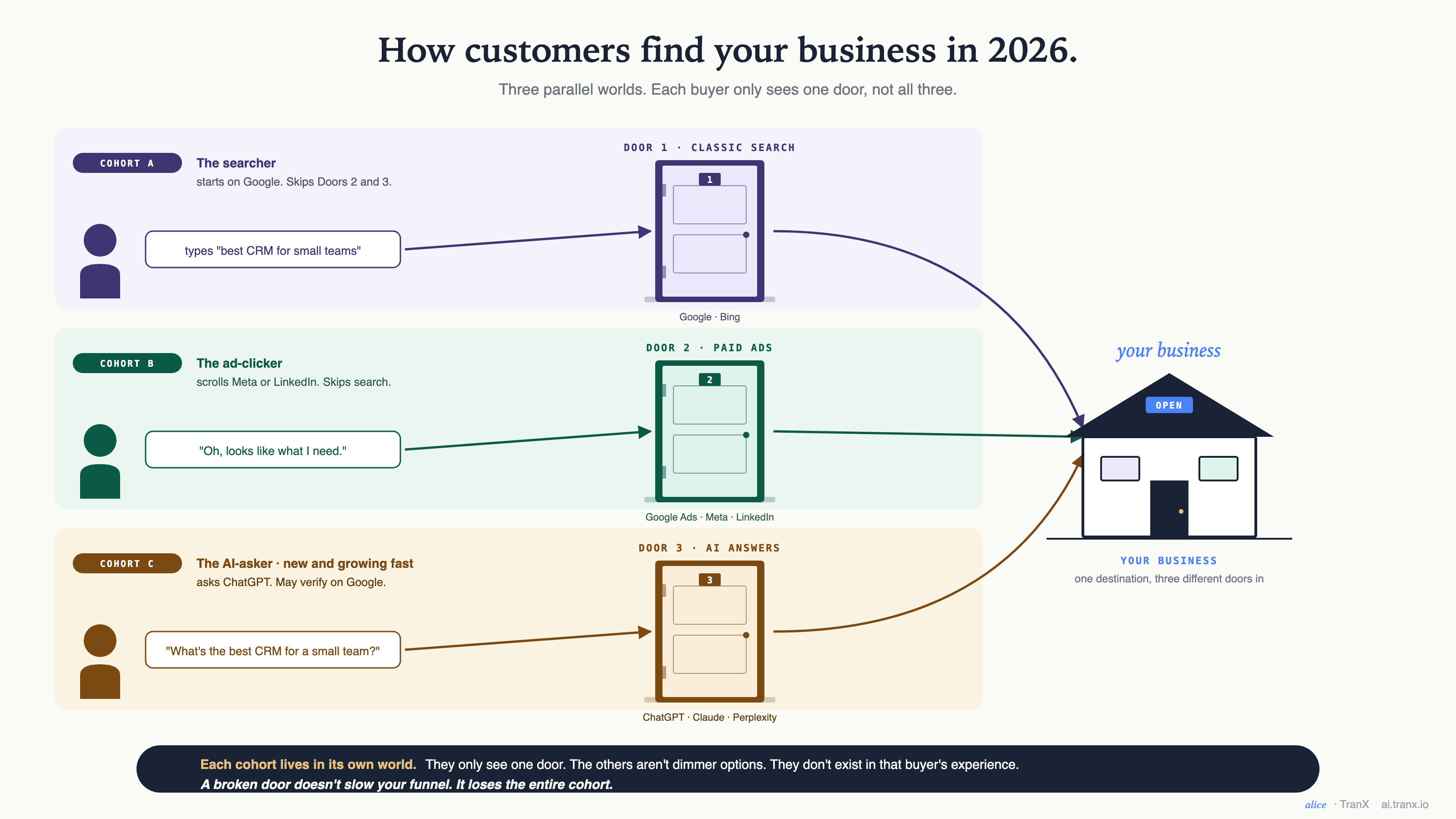
In 2026, acquisition is three doors, and one of them didn't exist in 2007.
The three doors:
- Classic search. Google blue links. Still here. Still big. Mostly stable, modulo Core Update headaches.
- Paid ads. Google Ads, Meta Ads, LinkedIn Ads. Still here, broken differently than they used to be. Privacy regulations made attribution noisier. iOS changes broke Meta's conversion API for years. GA4 is a different mental model from Universal Analytics.
- AI answers. ChatGPT, Perplexity, Claude, Google's AI Overviews. Citations from AI engines. This one is new. It started accelerating in 2024 and by 2026 it's a real fraction of "how did you find us" answers in customer onboarding surveys — especially for B2B SaaS in technical categories, where buyers Google less and ask Claude more.
AARRR has no native place to put door three. If a team grafts AI Overview citation tracking onto "Acquisition," they end up with one box trying to hold three completely different motions: ranking in search, optimizing ad spend, and getting cited by language models. Those are not the same job. They don't share metrics. They don't share tooling. They don't share intuition.
A B2B SaaS founder who diligently tracked Acquisition in AARRR terms can have a great Google Ads ROAS, a respectable SEO position, and still be utterly invisible inside ChatGPT — increasingly the place their buyer asks the question that decides who gets considered.
That's a real gap. It isn't fixed by harder work inside the AARRR frame. It's fixed by zooming in.
The three-layer reframe
Building Alice, the AI growth agent we make at TranX, we kept seeing the same pattern. The front of AARRR is actually three questions, not one. Each maps to a different door, a different toolchain, and a different way to fail.
Layer 1, Discovery: Can they find you?
This is the door question. Two sub-doors live here:
- Classic search — rankings, query CTR, indexability
- AI answers — do ChatGPT, Perplexity, and Google AI Overviews cite you for the queries your buyer is actually asking
Most teams track the first sub-door and ignore the second. Most "Acquisition is fine" assessments hold up under classic search and fall apart under AI citation.
Layer 2, Perceivability: Do they feel it's for them?
This is the bridge question. They found you. Now: did the ad or the search result actually look like the answer to their problem? Did the landing page convince them in eight seconds? Did they engage on-site, or bounce?
This is the layer where most B2B SaaS funnels actually leak. People click. They just don't believe.
Layer 3, Activation: Do they reach value?
This is the value question. Signup happened. Did they actually do the thing that makes the product worth paying for? For a CRM, that's "imported your contacts." For a dev tool, that's "first API call." For an analytics product, that's "connected a data source."
If they reach value, AARRR's Retention loop has a chance. If they don't, AARRR's Retention loop has nothing to measure.
Three layers. Three different questions. Three different ways acquisition can break. One box in AARRR.
Why this matters in 2026
This isn't a pedantic relabeling exercise. The reason the reframe matters is what keeps showing up in real B2B SaaS founders' data.
The pattern, again and again:
- On-page SEO is fine. The site is technically clean.
- AI readiness is fine. Schema markup, server-rendered content,
llms.txtall check out. - The site is utterly absent from ChatGPT and Perplexity answers for queries the buyers actually ask.
In AARRR vocabulary, Acquisition is "working." Traffic exists. Signups exist. In the three-layer frame, Discovery is broken on door three. AI engines aren't citing them.
Ready is not the same as cited. AARRR doesn't surface that distinction. The reframe does.
This isn't a hypothetical. It's most of the founders we've talked to in the last six months.
Honest scope
This isn't a replacement of AARRR. It's a replacement of one stage of AARRR with three sharper ones.
Retention, Referral, and Revenue still belong to AARRR. Alice doesn't analyze them yet. Anyone asking Alice today about churn cohorts or referral attribution gets an honest not my layers yet.
If a reader gets to this point and thinks "are these guys saying AARRR is bad" — no. One box in AARRR can no longer hold what it used to hold. Five layers is a fine number. We just spell the first one with three letters of our own.
What to do
For how the three layers connect to the board metrics you already report — NRR, CAC payback, Rule of 40 are lagging indicators; the layers are the levers that move them — read the companion: leading vs lagging SaaS metrics.
For a free check on door three — whether a site is technically ready to be cited by ChatGPT, Perplexity, and Google AI — Alice runs it in 30 seconds at ai.tranx.io. No card.
For knowing whether a site is actually cited — which buyer questions, impression share, the queries where it's one step from being picked instead of a competitor — that's the paid layer. Plans start at $99/mo on Visibility, with the outcome join on Impact at $149/mo. Every paid plan comes with a 30-day money-back guarantee — no seat caps, no countdown.
Either way, the question worth asking this quarter isn't "is my Acquisition stage working." It's which of the three doors is broken. Pick the right framework and the answer is two minutes away.