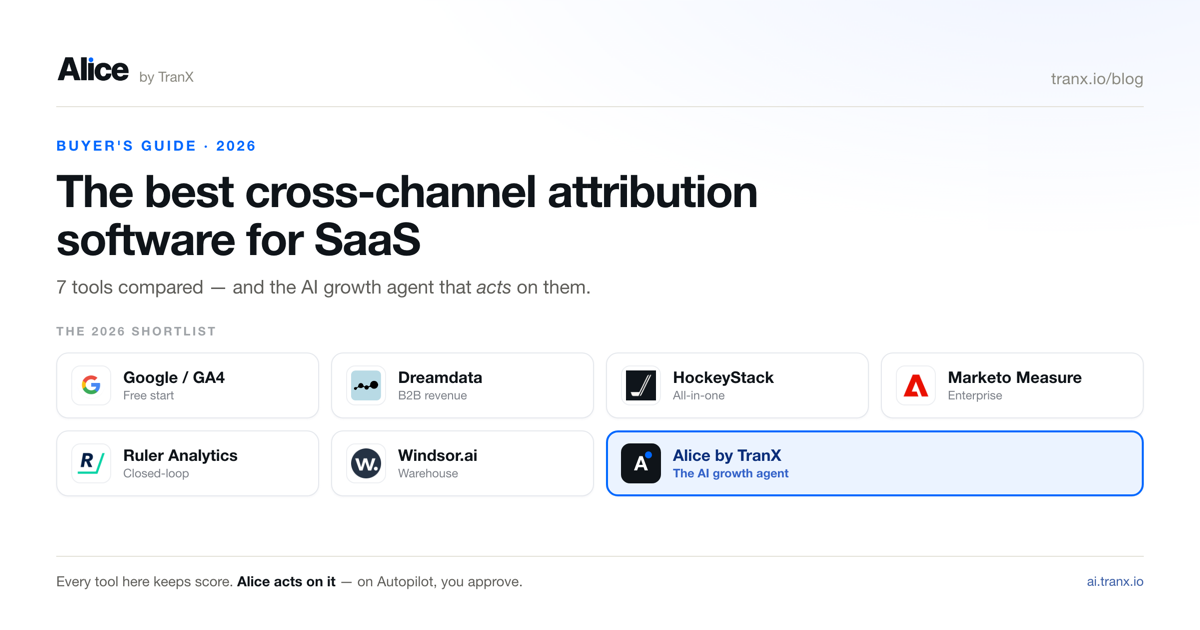
Search "best cross-channel attribution software" and you get twenty listicles that all rank the same tools and never tell you the thing that matters: which one fits your stage, your motion, and your budget — and what still breaks after you buy it. This is the honest version. We'll define what cross-channel attribution software actually does, walk a shortlist for B2B SaaS in 2026 with a clear "best for" on each, and be straight about where our own tool (Alice) fits and, just as importantly, where it doesn't.
What "cross-channel attribution software" actually means
Attribution is the practice of assigning credit for a sale to the marketing touches that led to it. Cross-channel attribution does that across every source at once — Google Ads, Meta, LinkedIn, organic search, AI answers, email, referrals, direct — instead of trusting each platform's own scorecard. And that's the whole reason the category exists: every ad platform counts every conversion it touched, so the numbers don't reconcile.
Here's the trap most buying guides fall into: they treat "attribution software" as one box you purchase. It isn't. It's three distinct jobs, and different products are best at different ones. Get the layers straight and the shortlist picks itself.
- Collect — capture every touch across channels and stitch them to one identity. This is GA4, a CDP like Segment or RudderStack, ad pixels, and server-side events. If a channel isn't collected, no model can credit it.
- Model — assign credit from touches to closed revenue (first-touch, last-touch, linear, time-decay, or data-driven / algorithmic). This is the layer the "attribution software" category usually means: Dreamdata, HockeyStack, Adobe Marketo Measure, Ruler.
- Reconcile & watch — decide which number to trust when the model, the ad platforms, GA4, and Stripe all disagree, and catch it the week a channel's numbers drift. Almost everyone does this by hand in a spreadsheet, or not at all.
The shortlist: best cross-channel attribution software for SaaS in 2026
Ranked by where they fit, not by a made-up score. Pricing moves constantly, so we describe the tier (free / mid-market / enterprise) rather than quoting numbers that'll be stale by the time you read this — check each vendor's site for current plans.
1. GA4 + BigQuery export — best free starting point
Before you buy anything, GA4 already does cross-channel attribution: its default conversion model is data-driven (though its channel reports still use paid-and-organic last-click — which is why the GA4 bar in Fig. 1 looks the way it does), it splits traffic into channel groups (including the newer AI-assistant channel), and the free BigQuery export hands you raw, unsampled event rows to build any model the UI won't. For a SaaS under roughly $20k MRR, GA4 done properly is genuinely enough. Its ceiling: it doesn't know your CRM pipeline or closed-won revenue, and the reporting UI distorts once you scale. Best for: every SaaS, as the free floor you build on. Tier: free.
2. Dreamdata — best for B2B SaaS revenue attribution
Purpose-built for the long, multi-touch B2B journey where a deal touches ads, content, sales, and product over months. Dreamdata joins marketing and sales touches to closed revenue in your CRM and handles both PLG and sales-led motions, which is exactly where generic ecommerce-flavored attribution tools fall apart. Best for: B2B SaaS that wants marketing tied to pipeline and revenue, with a warehouse-friendly backbone. Tier: free tier for smaller volumes, then mid-market.
3. HockeyStack — best no-code all-in-one
Bundles multi-touch attribution with journey and funnel analytics in one place, with no-code event tracking and a library of attribution models you can switch between — no SQL, no data pipeline to stand up. It now positions as a broader B2B revenue-data platform (with its own AI analyst, Odin), but the core draw for a marketing team is attribution and reporting without engineering. Best for: marketing-led B2B SaaS teams wanting attribution + analytics without SQL. Tier: mid-market.
4. Adobe Marketo Measure (Bizible) — best for enterprise B2B
The incumbent for large Salesforce + Marketo organizations with a formal marketing-ops function. Deep, configurable multi-touch models and enterprise governance — and enterprise price, implementation time, and admin overhead to match. Overkill for a founder-led team; the right call for a 50-person marketing org. Best for: enterprise B2B on the Adobe/Salesforce stack. Tier: enterprise.
5. Ruler Analytics — best for closed-loop, lead-based funnels
Strong at closing the loop between a lead source and the revenue it eventually produces, including offline touches like phone calls, forms, and live chat. If your funnel is demo- or consultation-led rather than pure self-serve, Ruler's call-and-form tracking is a real edge. Best for: demo-led SaaS and agencies that need offline conversions tied back to source. Tier: mid-market.
6. Windsor.ai / Supermetrics + a warehouse — best build-your-own
Not attribution tools themselves — they're the pipes. Connectors like Windsor.ai, Supermetrics, or Fivetran pull every channel's data into BigQuery (or a BI tool like Looker), and you own the attribution model in SQL and dbt. Maximum flexibility and no per-seat model tax; in exchange you own the maintenance and need someone who can write the queries. Best for: teams with data-engineering capacity who want full control. Tier: the connectors are cheap (Windsor.ai starts around $19/mo; Supermetrics and Fivetran run higher) — the real cost is your warehouse and the engineering time to build and maintain the model.
7. Alice by TranX — the AI growth agent, not another scorekeeper
Full disclosure: this is us, so weigh it accordingly. Here's the honest line first: Alice is not a multi-touch attribution model, and we won't pretend it is — if you need to assign fractional credit across a 14-touch B2B journey, pick Dreamdata or build it in your warehouse. But that's a smaller job than the one most founders actually have. Every other tool on this list is a scorekeeper: it reports what already happened and leaves the doing to you. That's the ceiling of the whole category — even perfect attribution is a passive readout. Alice is a different kind of product: an AI growth agent, and two differences matter.
No setup tax. The others are implementation projects — pipelines to build, models to configure, SQL to learn, admins to staff. Alice is OAuth and plain English: connect GA4, Search Console, Google Ads, Meta, and Stripe — plus your organic social (YouTube, Facebook, Instagram) and your BigQuery warehouse — in a few minutes and ask her like you'd ask an analyst. There's no dashboard to learn and no model to tune. She reconciles the places your sources disagree (Fig. 1) and tells you which number to trust — and because she sees organic social next to paid and search, "which channel wins" extends to which video or post actually sent the traffic and the signups, not just the paid line items.
She acts — proactively. A scorekeeper flags that a channel slipped and stops there. Alice's Autopilot (Beta) takes a growth goal you set and works the funnel toward it — finding the leak and drafting the fix, not just reporting it — and because she's an agent that re-reads your funnel every week, she also catches the week a channel's conversions quietly drift 30% (usually a broken tag, not a real change). You approve every move before anything ships. The point isn't to allocate credit for the users you already have — it's to go get more.
Best for: founders running their own growth who want the funnel fixed and pushed forward, not just measured — and who'd rather ask a question than maintain a tool. Tier: free to start, no card.
The comparison, on one card
| Tool | Layer | Best for | Tier |
|---|---|---|---|
| GA4 + BigQuery | Collect + basic Model | The free floor every SaaS should nail first | Free |
| Dreamdata | Model | B2B revenue attribution, PLG + sales-led | Free → mid-market |
| HockeyStack | Model | No-code all-in-one for marketing teams | Mid-market |
| Adobe Marketo Measure | Model | Enterprise Salesforce + Marketo orgs | Enterprise |
| Ruler Analytics | Collect + Model | Closed-loop, call/form/lead funnels | Mid-market |
| Windsor.ai / Supermetrics | Collect (pipes) | Build-your-own model in a warehouse | Cheap connectors + warehouse/eng time |
| Alice by TranX | Agent (reconcile + act) | Fixing the funnel & getting more users, not just measuring | Free to start |
How to actually choose
Skip the feature grid and answer three questions in order.
1. What's your motion? Self-serve / PLG lives in GA4, product analytics, and Stripe — start there and add Dreamdata or HockeyStack when you need touches tied to revenue. Demo- or sales-led means the credit has to reach your CRM: Dreamdata, Ruler, or Marketo Measure, depending on size.
2. What's your stage? Under ~$20k MRR, resist buying a platform — GA4 done right plus a reconciliation habit beats an expensive model you won't configure. $20k–$150k MRR is where a dedicated model (Dreamdata / HockeyStack) starts paying off. Enterprise is where Marketo Measure or a warehouse build earns its keep.
3. Who maintains it? Be honest about whether anyone will own the model. A warehouse build is the most powerful and the fastest to rot without a data owner. If the answer is "the founder, at 11pm," weight simplicity and monitoring far more than model sophistication.
And step back before you buy anything at all. Every option above is a scorekeeper: it measures, then hands the work back to you — reconciling the numbers, chasing the leak, shipping the fix. If you have a team to do that, pick the model that fits and go. If you're the founder doing it at 11pm, the more useful question isn't "which tool measures best" but "what will actually move the funnel this week" — and that's a job for an agent, not a dashboard.
Curious how far apart your own numbers actually are? Connect GA4, Google Ads, Meta, and Stripe and Alice reconciles them for you — free, no card — tells you which one to trust, and, on Autopilot with your approval, works the funnel toward more signups.
Try Alice free →Frequently asked
What is the best cross-channel attribution software for SaaS in 2026?
There isn't a single winner, because attribution is three jobs. For B2B SaaS in 2026: start with GA4 + BigQuery (free), add Dreamdata for revenue-grade B2B attribution or HockeyStack for a no-code all-in-one, use Adobe Marketo Measure at enterprise scale, Ruler for lead/call-based funnels, or a Windsor.ai/Supermetrics + warehouse stack to build your own. Then add a reconciliation layer — a spreadsheet, a hire, or a tool like Alice — because the models still disagree with your ad platforms and Stripe by 20–30%.
Why don't my Google Ads, Meta, GA4, and Stripe numbers match?
Because they measure different things at different moments. Each ad platform counts every conversion it touched (so they over-count in aggregate), GA4 credits the last non-direct click and loses some sessions to "direct" and adblockers, and Stripe only knows who actually paid. A 15–30% gap between these tools is normal, not a bug. Cross-channel attribution software exists to reconcile the disagreement; see our deep dive on Google Ads vs GA4 blind spots.
Do I need paid attribution software, or is GA4 enough?
For most SaaS under ~$20k MRR, GA4 set up correctly — data-driven attribution, proper channel groups, and the BigQuery export enabled from day one — is enough, and free. You outgrow it when you need marketing touches tied to closed CRM revenue across a long B2B journey, at which point a purpose-built model (Dreamdata, HockeyStack, Marketo Measure) starts to pay for itself. Don't buy a platform to avoid setting up the free one properly first.
What's the difference between an attribution model and a CDP?
A CDP (Segment, RudderStack) is a collect tool: it captures events and unifies them to one customer identity across channels. An attribution model is what turns those unified touches into credit for revenue. The CDP feeds the model; it isn't the model itself. Many teams have a CDP and still have no attribution because nobody built or bought the modeling layer on top.
How does Alice compare to Dreamdata or HockeyStack?
They solve different jobs. Dreamdata and HockeyStack are modeling tools — they assign multi-touch credit across the journey, and you act on what they report. Alice is an AI growth agent — it sits on top of GA4, Search Console, Google Ads, Meta, and Stripe with no setup project, reconciles which number to trust when they disagree, answers questions in plain English, and — on Autopilot, with your approval — proactively works the funnel toward more signups rather than just reporting. If you need formal multi-touch credit, use a modeling tool; if you want the funnel fixed and pushed forward without hiring for it, that's Alice. Many teams end up wanting both.