Does Google Search Still Matter When Buyers Use AI?
Yes, Google Search remains worth tracking alongside AI answers. Buyers can use AI to discover options and search to investigate them further. Recent survey evidence supports this complementary role, though it does not establish how every buyer behaves or predict Google’s future traffic.
We recently added Google Search keyword tracking to Alice, our AI marketing agent.
The idea came into focus during a couple of conversations with marketers. I wanted to understand how they were thinking about AI answers and the way customers discover businesses. The conversation kept returning to SEO and keywords: what people search for, where a business appears, and how to follow those changes.
That was useful feedback. Keywords were already part of how they understood their work. Helping them track those searches would give Alice a familiar starting point alongside the buyer questions she monitors in AI.
But feedback raised a second question for me: as more people ask AI for recommendations, does tracking Google keywords still deserve investment?
After looking at the research, I think it does. One reason is that asking AI and searching the web can be parts of the same decision. A buyer may discover an option in an AI answer and then search for evidence that it is right for them.
That is the thinking behind this feature: help businesses follow both ways buyers look for them, while keeping the measurements clear.
An AI recommendation can start the investigation
Imagine you need an office chair for a small home office.
You could ask an AI assistant: “Which office chairs work well in a small room if I sit for six hours a day?” It might explain which features matter and suggest a few options.
Before buying, you might want to check the dimensions, read customer reviews, compare prices, or find out whether a chair can be returned. You could search Google, open a retailer’s page, watch a video, or ask the AI a follow-up question.
There are several possible routes. AI may help narrow the options, while search helps you inspect the evidence. Someone else could begin with Google and ask AI to explain the differences afterward.
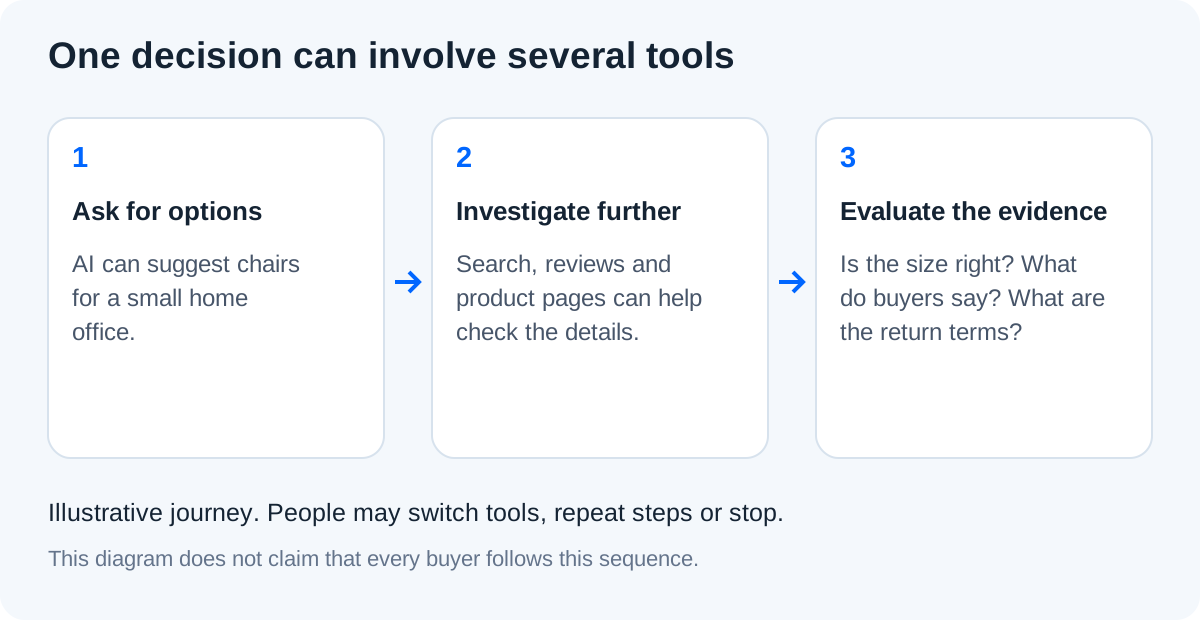
An illustrative journey, not a measured sequence. People can move between tools, repeat steps, or stop without buying.
For a business owner, the useful question becomes: can buyers find and check the information they need about your business at each of those moments?
A recent survey shows that checking still matters
Product.ai’s report, published on October 14, 2026, surveyed 1,493 U.S. shoppers from August 27 to September 1. Among the 517 online shoppers who had used AI for product research, 89.9% said they always or sometimes checked recommendations through another source before buying. That includes 41.0% who said they always check and 48.9% who sometimes do. Read the survey and methodology.
The report also asked 493 respondents who verify AI recommendations where they went first on their most recent check. Customer reviews led at 36.7%, followed by a search engine at 21.9% and a brand or retailer website at 14.0%. The search-engine finding is not specific to Google. See the verification results.
These are self-reported habits from an unweighted U.S. panel survey. They do not show how every buyer behaves, or establish the same pattern for every industry or country. Product.ai also sells a product in this area, which is worth keeping in mind when interpreting its research.
Still, the finding gives us a useful reason to consider search as part of an AI-assisted purchase journey. A recommendation can lead to further checking.
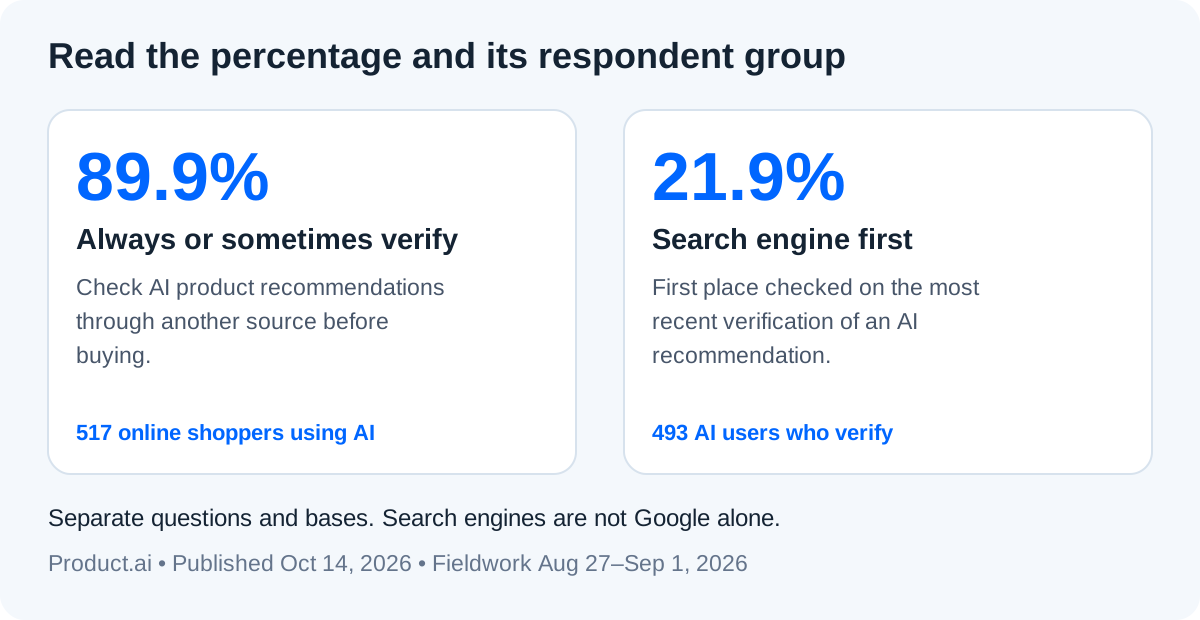
The percentages describe different groups and questions. Neither percentage means that nine in ten shoppers search Google after every AI answer. Source: Product.ai, October 2026 report.
Keywords and AI questions express related needs
A keyword is a word or phrase someone types into a search engine. A buyer question is a question someone asks while trying to understand a need, compare choices, or select a business.
The wording can be different even when the underlying need is similar.
| What the buyer needs | A Google Search keyword | An AI buyer question |
|---|---|---|
| A chair for a small room | office chair for small spaces | Which office chairs fit a small home office? |
| A manufacturer for an initial order | low minimum order custom packaging | Which packaging suppliers can handle a small first production run? |
| Help with appointments | appointment booking for salons | Which booking tools help a small salon manage appointments? |
Illustrative wording, not measured search-volume data or actual customer queries.
This is the shared idea behind Alice’s monitoring: follow the needs buyers express, whether they type a short search phrase or ask a detailed question.
You do not need to learn a new set of marketing acronyms to begin. Start with what your customers want to find out before choosing you.
Keep Google rankings and AI mentions separate
Related buyer needs do not make the results interchangeable.
A Google keyword ranking describes where a page appears for a tracked search under particular conditions. Rankings can vary by location, device and time.
An AI mention means the business is named in a checked answer. A citation means an answer links to a page on the business’s website. An answer can mention a business without linking to it, and different questions or engines can produce different results.
Google also includes AI-generated answers within Search. That makes the distinction between a conventional ranking and inclusion in an AI answer useful even within Google itself.
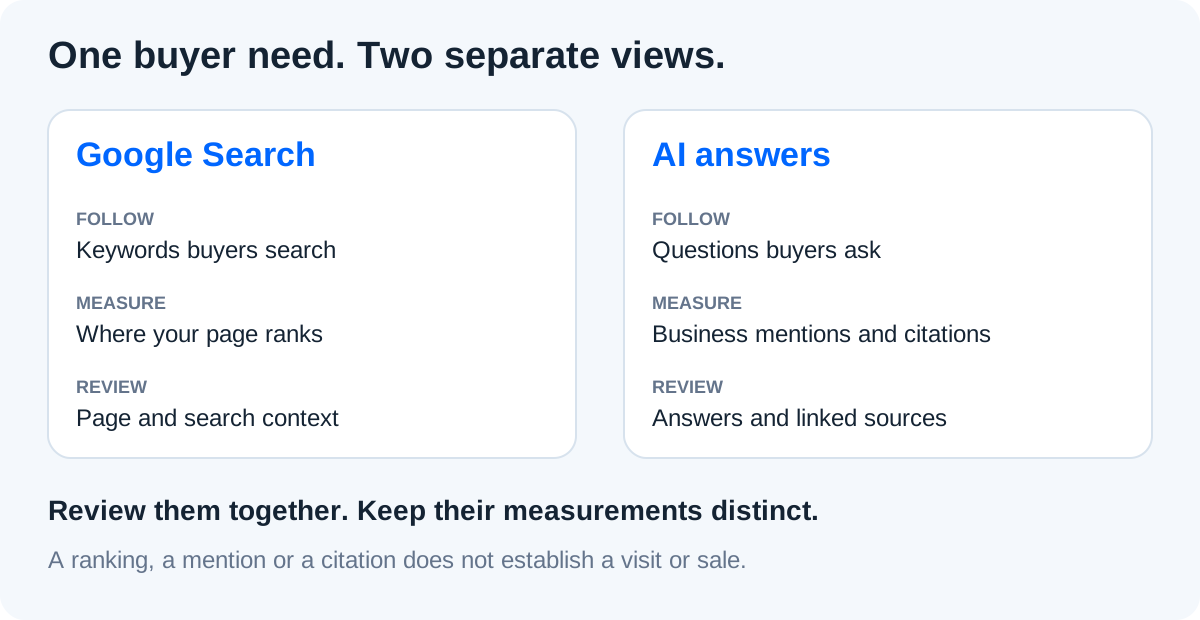
The two views complement each other. A ranking, a mention and a citation each describe something different; none alone establishes a visit or sale.
If your page ranks for a relevant keyword but your business is absent from the AI answers you check, you have two findings to investigate. If AI mentions your business but the answer leaves out an important service, you have another question to examine.
The next step is to inspect the relevant pages, answers and sources. Improving the information buyers can find is useful work, even though no edit guarantees a higher rank or an AI citation.
What the new support adds to Alice
Alice now lets you choose Google Search keywords relevant to your products, services and buying decisions, track rankings over time, and review the history alongside your AI visibility trends.
That sits alongside her existing work: suggesting buyer questions, checking AI answers, examining competitor citations, and recommending pages or topics to review. She helps you understand what changed and what deserves attention next.
For example, an office furniture business could follow the keyword “office chair for small spaces” and a related AI question about chairs for a small home office. It could then review whether its product pages clearly explain dimensions, adjustment options and return terms. Those are proposed checks, not a promise that the same page will rank or be cited.
Alice is designed for business owners and small teams without SEO or technical knowledge. The goal is to make findings understandable and the next step practical.
Will Google Search still matter in the coming years?
My assessment is that Google Search remains worth following, while its role continues to change. The evidence of buyers checking AI recommendations supports keeping search in the picture today. It does not predict how much traffic any particular business will receive several years from now.
The value of keyword tracking should therefore be judged by the decisions it helps you make. Does it reveal a relevant page that needs attention? Does it help you notice a change worth investigating? Does it help you choose which customer need your next article or service page should address?
We will keep asking those questions as we develop Alice. The conversations with marketers helped us see an immediate need; the subsequent research gave us more reason to keep working on it. Continued investment should depend on whether it helps people do useful work.
If you are starting today, choose a small set of searches and questions tied to what you actually sell. Follow them consistently. Review what appears, check the evidence on your pages, and make one useful improvement at a time.
Your buyers can use both. Alice helps you keep an eye on both.
Start with your website URL. Alice is designed for people without SEO or technical knowledge, with first website-check results in 30 seconds. That initial check is a snapshot; ongoing monitoring follows changes over time.
Follow how buyers find your business
Track Google Search keywords alongside AI buyer questions, with rankings, mentions and citations kept distinct. Alice helps you see what changed and decide what to review next.
Try Alice Free