Too Generic to Get Cited? Why AI May Be Overlooking Your Business
AI knew the brand. The website scored 100/100 on our technical readability checks. But when we asked AI to help find a supplier, the company did not appear in the answers we tested.
That was the gap we discussed in a recent meeting with a small manufacturer. We are keeping the company and its products anonymous. The useful lesson is one many businesses can apply: a website can be easy to read and still say too little about why a particular buyer should choose you.
Using Alice, our platform for understanding and improving visibility in AI answers, we reviewed the site and the sources appearing in the buyer searches. One opportunity stood out: replace generic descriptions with useful details about the customers, requirements and projects the business can serve.
This is an initial review, not a before-and-after success story. We have not measured the effect of the proposed changes, and the checks do not prove that generic wording caused the company to be absent.
AI readability, brand recognition and recommendations are different checks
A technical score tells you about the checks a tool performed. In this case, 100/100 described the website’s technical checks on our platform. It was not an overall AI recommendation score, a Google score or proof that every page was indexed.
Asking about a company by name also supplies a clue that an unfamiliar buyer will not have. It tests whether AI can respond about that brand. Asking for a supplier tests whether the company appears for a buying need without that clue.
Can AI read it?
Are the important words and facts accessible?
Technical readability
Does AI know you?
What happens when the question names your brand?
Brand recognition
Do buyers find you?
Do you appear when the question describes a need?
Buyer discovery
In the three AI search checks documented for this review, the brand question passed the citation check, while the buyer question did not return a citation to the company. That is a limited snapshot, not an overall recommendation rate.
For your own business, record three outcomes separately: a mention names you, a citation links to a page as a source, and a recommendation presents you as a potential choice. A citation does not necessarily endorse a supplier.
Why trying to appeal to everyone can make your website less useful
Businesses often describe themselves broadly because they want more opportunities. The concern is understandable: “If we sound too specific, we might turn customers away.”
So the homepage promises quality products, innovative solutions and excellent service. Those may all be true. But they could describe thousands of companies, and they leave a buyer to work out whether the business meets their particular requirements.
Specific information helps that evaluation. A buyer might need a supplier that handles a certain material, supports an existing design, serves a particular market or explains how a smaller project is assessed. If those details are missing, a polished introduction still leaves important questions unanswered.
Our working hypothesis is that making those real capabilities explicit can make the page more relevant to specific buyer questions. We need repeated checks after publication to see whether that happens.
“We build electric cars” gives buyers very little to work with
Consider a hypothetical example, unrelated to the manufacturer we reviewed:
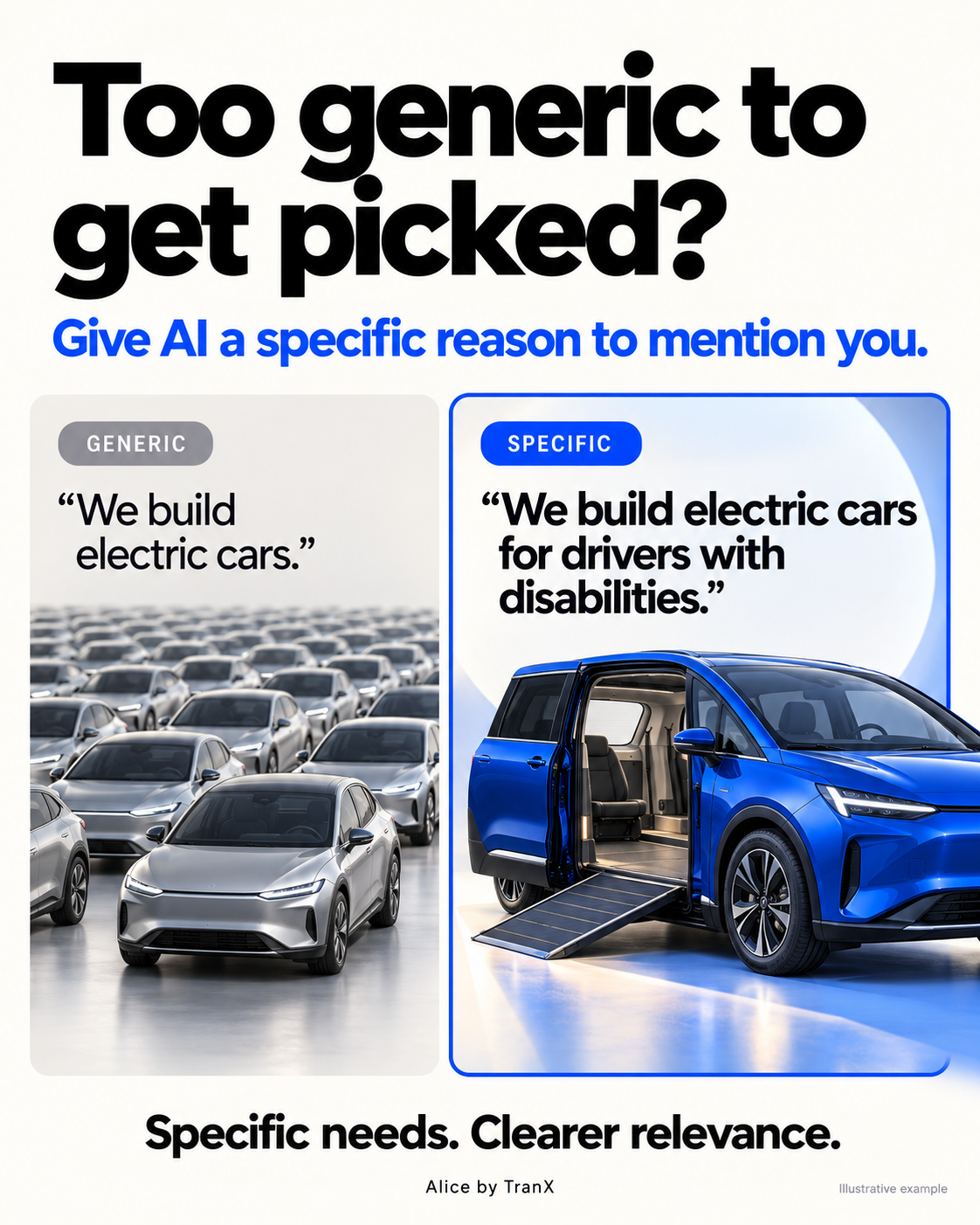
We build electric cars.
You are describing a huge category that includes established names such as Tesla. The sentence offers little reason to consider your business for a particular need. It does not mean a smaller company can never appear for a broad question; it means the description does little to distinguish it.
Now consider:
We build electric cars designed for drivers with disabilities.
The second sentence identifies a customer group and a design purpose. It creates a more useful starting point for someone researching accessible vehicles.
The page would still need to explain the actual adaptations, intended users, availability and supporting evidence. A sentence alone cannot establish accessibility or earn a citation. Specificity works best when it makes genuine expertise visible.
What to add instead of another generic claim
Start with one important service page. Write down the questions your sales team repeatedly answers before a prospect can judge whether you are a fit.
| Generic claim | Useful detail to add, if true |
|---|---|
| We serve every industry. | Name the customer groups and applications you have experience supporting. |
| We offer customized solutions. | Explain what can be customized and what the customer needs to supply. |
| We offer flexible production. | Describe how order size, materials and project requirements are assessed. |
| We deliver excellent service. | Explain the stages from first inquiry to evaluation, samples and quotation. |
Support those details with examples, specifications, relevant project experience or documents you are allowed to publish. Have the people responsible for delivery verify claims about capacity, certifications and commercial conditions.
You do not need to narrow your entire business to one niche. Keep a broad overview, then link to focused pages for your most important services and buyer needs. Each page should help someone make a decision rather than repeat the same introduction with different keywords.
Give interested buyers a clear next step
Our proposed improvements also covered the inquiry journey. This was an opportunity to clarify the process, not evidence of a broken form.
After explaining a service, tell buyers what information helps you assess their project and what to expect after contacting you. Depending on the business, that might include intended use, quantity, specifications or destination market.
Keep the first inquiry manageable. Explain why you need each detail and let buyers say when they are unsure. Do not promise a response time unless your team can consistently meet it.
How to test whether clearer content helps
- Choose a small set of real buyer questions. Include needs and constraints, not only your brand name. Keep the question wording, language, market and search settings recorded.
- Save a baseline. Keep dated answers and cited URLs across repeated checks. Note when an answer has no sources or a tool fails, rather than treating missing evidence as a confirmed miss.
- Improve one relevant page. Add verified information that answers the chosen questions. Keep a record of what changed and when.
- Repeat the checks over time. Look for patterns, including whether the edited page starts appearing as a source. One favorable answer does not prove the edit caused it.
- Review buyer response separately. Track relevant inquiries and their quality, but do not assume an increase came from AI without supporting evidence.
Our guide to checking whether AI recommends your website explains how to set up those checks. If you suspect a reading problem first, see our website readability experiment.
Where this fits into GEO and SEO
GEO, or generative engine optimization, refers to work aimed at visibility in AI answers. SEO focuses on visibility in search. Clear, useful service pages matter to both because they help people understand what you offer.
For Google specifically, its guidance for AI features says existing SEO foundations remain relevant, with no special additional requirements for AI Overviews or AI Mode. It emphasizes accessible text and helpful content, and does not guarantee inclusion. That guidance should not be treated as a statement about every AI tool.
The practical question is simple: does your website explain why a particular buyer should consider you? A clear answer is worth writing even before you know whether it will change an AI response.
Frequently asked questions
Why does AI recognize my brand but not recommend my business?
A question that names your brand and a question that asks for a supplier test different things. Brand recognition does not establish that your business will appear for a particular buying need. Review your technical accessibility, the relevance and evidence on your pages, and the sources cited in the answers you test.
Does a perfect AI readability score mean AI will cite my website?
No. A technical score describes the checks that tool performed. It does not measure overall recommendation frequency, prove that every page is indexed, or guarantee inclusion in AI answers.
Can specific website content help with GEO and SEO?
Specific content can make it clearer which customers you serve and which needs you meet. That makes the page more useful to buyers and gives search systems explicit information to work with. It does not guarantee a citation or ranking, and this review did not establish a causal effect.
How can I be specific without excluding other customers?
Keep an overview of your full offering and create focused service pages for important customer needs. Link them together and describe only capabilities you can substantiate. Specific pages do not require narrowing the entire business.
Does your business appear for your buyers’ questions?
Alice helps you understand your visibility in AI answers, review cited sources and identify website content worth improving.
Try Alice Free